Ecommerce
|
November 17, 2026
The DTC Playbook Is Breaking: 6 Predictions for Ecommerce in 2027



What if the next big DTC marketing channel isn't digital? What if AI makes brand building more important, not less? And what if the smartest growth strategy in 2027 is selling more of what already works, rather than launching something new?
These aren't the predictions you'd expect from an industry obsessed with the next platform, the next viral product, and the next growth hack. But after the year ecommerce brands have had, I think it's time to challenge a few assumptions.
2026 gave us plenty of reasons to question the traditional DTC playbook. AI-powered shopping gained momentum, changing how consumers discover and research products. AI-generated creative made it easier than ever to produce content, while raising new questions about what consumers actually trust. Digitally native brands pushed further into physical retail. And behind the scenes, operators were rethinking everything from inventory planning to customer acquisition as they worked to balance growth with profitability.
We built an interactive experience so you can ask our Magic 8 Ball yourself what's next for DTC and vote for how likely you think that prediction will come to pass. Then, come back here to read more about how you can prepare for 2027 below.

For years, the DTC growth playbook focused on bringing shoppers to a brand's own website, but some of the most interesting digitally native brands are moving in the opposite direction. Instead, they're taking the brands they've built online and putting their products directly into the places consumers already shop.
Look at Hulken. Its expansion into physical retail, including a Costco-exclusive XL rolling tote offering, illustrates how a digitally-driven brand can reach customers who might never have encountered one of its online advertisements. Hulken saw 50% YoY revenue growth from its wholesale operations.
In 2027, more digitally native brands will treat physical retail as both a customer acquisition channel and a way to make their products tangible, not merely as another wholesale revenue line.
There's something powerful about physically encountering a product. You can see it, touch it, understand its size, and imagine how it fits into your life. For certain categories, that experience can accomplish something a digital advertisement cannot. When ŌURA, the makers of the Oura Ring, expanded into Best Buy, their CMO Doug Sweeny, said in a press release, “this partnership allows us to bring ŌURA to life in a dynamic and visual way for a new audience across the country.”
The opportunity is significant, but so is the operational challenge. Wholesale relationships introduce different margins, inventory commitments, payment terms, and forecasting requirements.
The brands that get this right won't simply be available in more places. They'll create more opportunities for consumers to discover, experience, and choose their products.
What brands should do now: Think about physical distribution as part of your marketing strategy, not just your sales strategy. Coordinate retail launches with digital campaigns, evaluate the customer acquisition opportunity, and make sure your inventory and funding strategies can support the expansion.
As brands expand their reach, I think we'll see a shift in how they decide which products deserve their biggest bets.

In 2027, we’ll see ecommerce brands becoming more selective about where they place inventory bets.
Having more products creates more opportunities to sell, but they also create more inventory decisions, forecasting complexity, and capital tied up in stock. Clearco’s Ecommerce Growth, Explained 2026 report uncovered that 93% of brands made at least one significant change to their inventory planning in the last twelve months. But they aren’t all making the same changes.
More safety stock, less inventory and faster replenishment, ordering earlier, placing smaller orders more frequently. These strategies sound contradictory, but they aren’t. Brands are responding to different versions of the same problem: uncertainty.
As 2027 unfolds, the ability to identify a winning product, respond to demand, and replenish inventory efficiently will become increasingly valuable.
Marketing has an important role to play here: Campaign performance, customer feedback, social engagement, and purchasing patterns can provide early signals about which products are gaining traction.
What brands should do now: Connect your marketing signals with merchandising and inventory planning to see which products could become your next bestseller. Of course, generating demand is only half the equation and brands should be ready with the inventory and operational flexibility to fulfill it.
While identifying your bestsellers is important, there's another question brands should be asking: Who is buying them? Because the next phase of profitable growth won't just be about selling more of the right products. It will be about selling them to customers who keep coming back.

A first purchase can make an acquisition campaign look successful. But what happens afterward?
A customer acquired through a substantial discount may never buy again, while another customer might cost more to acquire but return repeatedly, purchase at full price, and generate substantially more value.
Brands will face continued pressure to grow profitably in 2027, driving acquisition strategies to connect more closely to retention, contribution margin, and customer lifetime value. According to Cydcor, the average annual Customer Retention Cost (CRC) is $88, while the cost to win a brand new retail buyer is a whopping $262.
There is a huge opportunity here. I hope to see more DTC marketers organizing their growth decisions around the quality of customers acquired rather than treating all conversions as equally valuable.
After all, a conversion isn't necessarily a win if the economics don't work beyond that first transaction.
What brands should do now: Understand which products and acquisition channels bring in repeat buyers, then measure customer cohorts, retention, and contribution margin—not simply the cost of acquiring the first order. Use those insights to influence which products you advertise, which audiences you prioritize, and how you allocate your marketing budget.
Something to expect in 2027 is that the first purchase may begin somewhere entirely new: with an AI-generated recommendation. The question is whether that’s enough to give consumers a reason to choose your brand?

Adobe reports AI-referred traffic to U.S. retail sites grew 71% YoY in September 2026, but getting onto a shortlist isn't the same as winning the purchase.
A shopper might ask an AI assistant for a skincare recommendation, receive several options, and then investigate those brands through reviews, creators, Reddit discussions, or social media before deciding.
The brands that benefit most from AI discovery won't necessarily be those that appear most frequently. They'll be the ones consumers recognize and have enough confidence in to buy.
In 2027, I expect more DTC marketers to treat brand building as part of their performance infrastructure rather than an entirely separate investment. Discoverability still matters. For example, Adobe also found that more than a third of the average U.S. retail homepage’s content isn’t visible to AI agents and platforms.
As consumers increasingly begin their buying journeys in AI systems, the ecommerce brands that will likely win the sale in 2027 are those investing in distinctive creative, earned media, customer advocacy, community reputation, and the trust signals that help consumers make a decision.
What brands should do now: Audit how your brand appears across AI recommendations, search, social platforms, and customer reviews. Use this information to develop the content, promotions, and messaging that make it ridiculously easy for customers to choose you.
Just as AI makes it easier for brands to get discovered and produce more content, standing out may become harder than ever. Which brings me to another prediction: where the next creative advantage will come from.
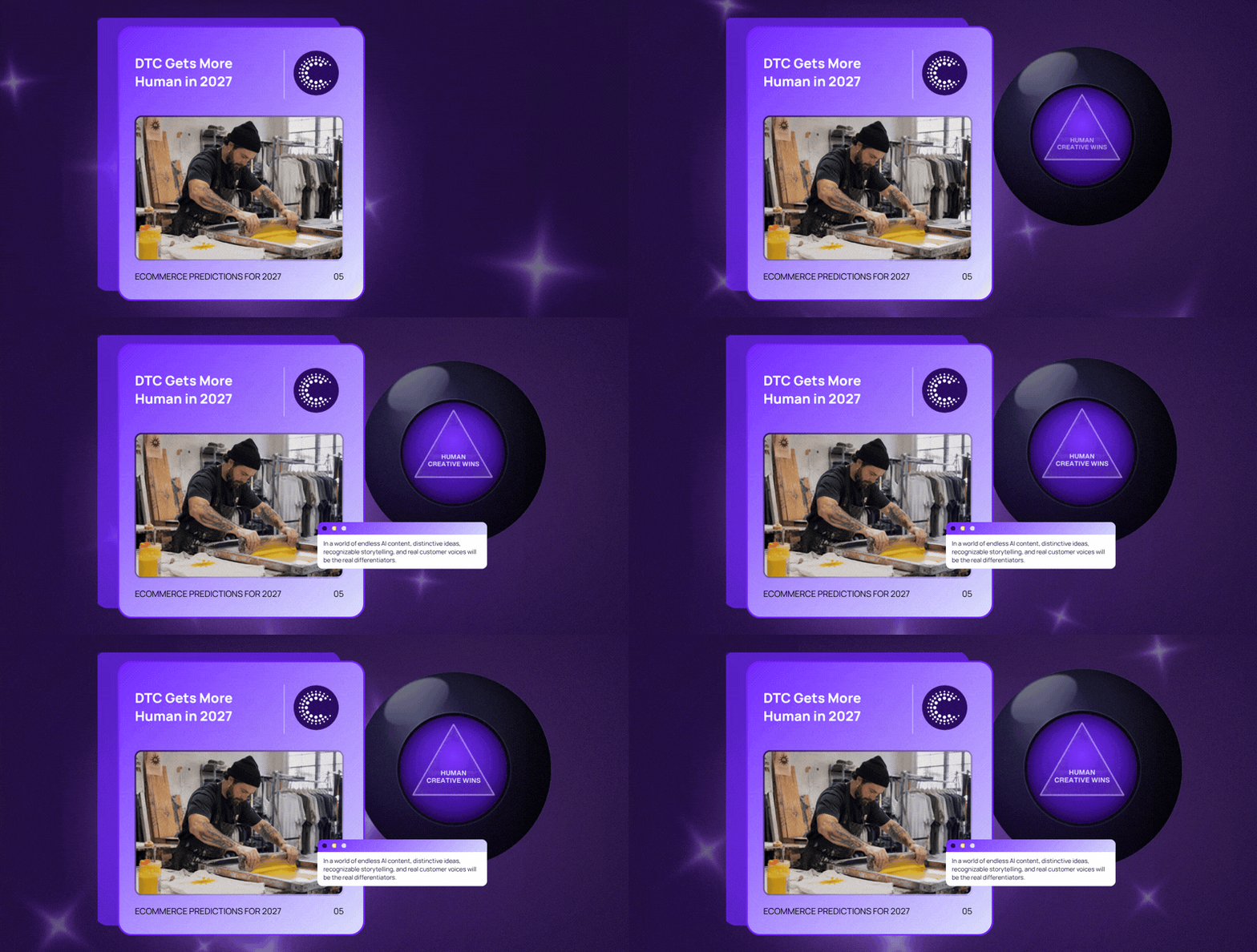
AI has made content production faster, cheaper, and easier, but that doesn't automatically make the resulting marketing more effective. Klaviyo reports that 32% of consumers trust a brand less for using AI-generated content.
When every brand can produce endless product images, ads, captions, and videos, distinctiveness becomes your competitive advantage.
The brands that stand out will have recognizable visual identities, original creative ideas, and consistent storytelling. And don’t underestimate the power of leveraging customers and user-generated content in your marketing. In two experiments with 300 adults, researchers labeled the same AI-generated paintings as either “human-created” or “AI-created.” The result? People rated the “human” ones as more profound and worth more.
While artwork isn't the same as ecommerce advertising, the finding raises an interesting question: as AI-generated content becomes more common, could the perception of human creativity become more valuable? I think so.
In 2027, I expect more DTC brands to move away from disconnected campaigns and toward recognizable creative platforms that build familiarity over time and lean further into their human strengths.
What brands should do now: Stop measuring creative success solely by how much content you produce. Invest in distinctive brand assets, original storytelling, and creative ideas that consumers will remember after they've scrolled past. And don’t forget to give real customers a bigger role in telling your brand's story.
And speaking of real people, there's one more area where I expect authenticity to become an even bigger competitive advantage
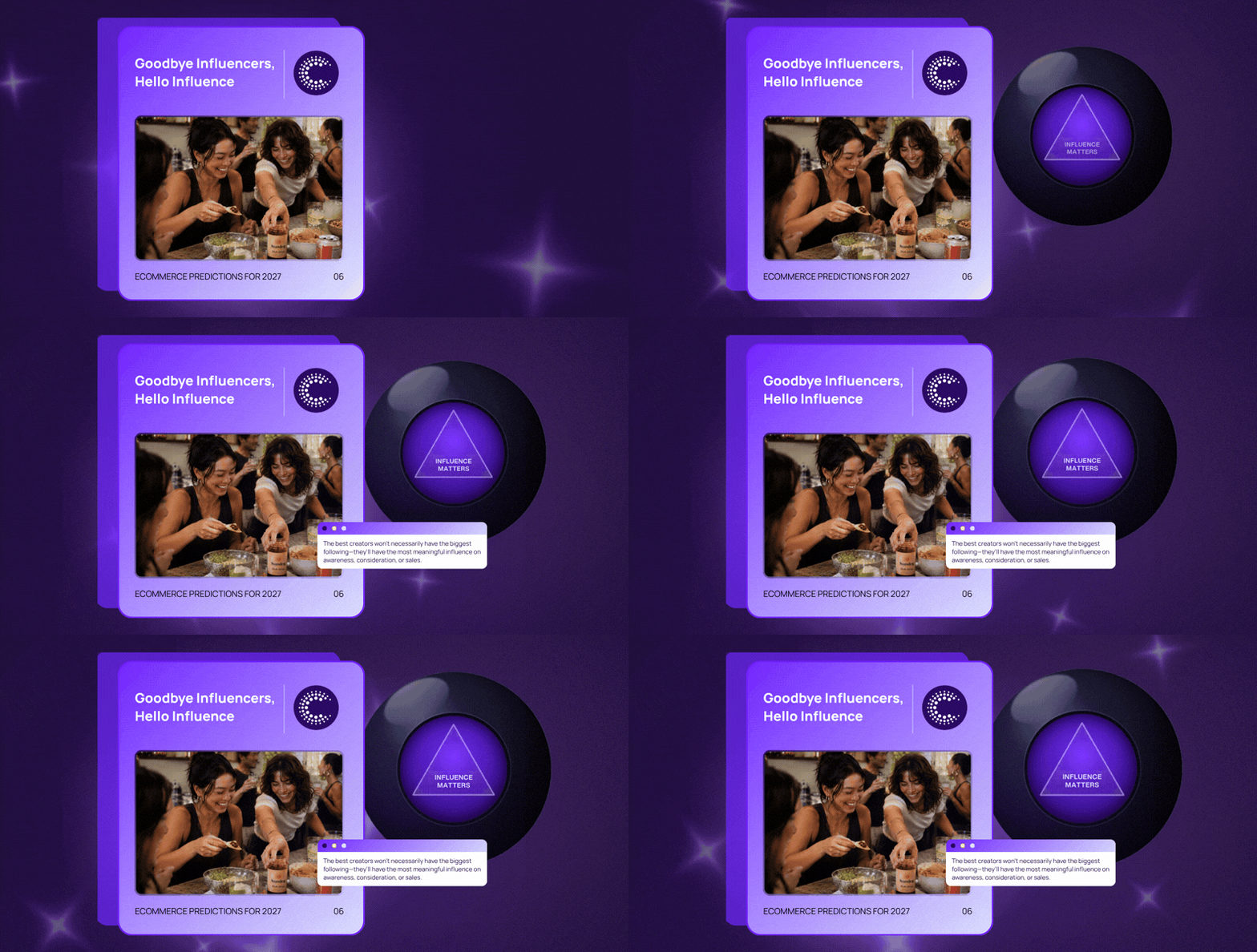
Creator marketing has become an established part of the DTC playbook and in 2027, we see more brands questioning whether they’re getting sufficient commercial value from these partnerships.
Reach and engagement still matter, as does the trust a creator has built with their audience. Micro and nano influencers (creators with follower counts typically between 1,000-100,000) have risen in prominence because of their focus on community building and targeted interactions. Omnicom Media Group shows that 50% of consumers consider these rising influencers relatable, while 42% view them as “real.”
As creator content becomes more closely connected to shopping experiences across TikTok, Instagram, YouTube, and marketplaces, I expect brands to become more deliberate about the outcomes they want from each partnership.
Not every creator needs to generate an immediate purchase, but every partnership should have a clear commercial purpose.
Some creators will build awareness. Others will introduce brands to highly qualified customers, particularly when they serve smaller, highly engaged communities. And others might be especially effective at demonstrating products and driving sales.
The opportunity isn't necessarily to find the creator with the biggest audience. It's to find the creator whose influence can genuinely move the right audience for you.
What brands should do now: Define what success looks like before signing a creator partnership. Evaluate their audience relevance, customer quality, incremental sales, and repeat purchasing alongside your traditional engagement metrics to understand how creators are contributing to your brand's growth.
For years, the DTC formula seemed relatively straightforward: reach a shopper, earn a click, convert the sale, and measure the return. But that formula doesn't fully account for how people discover products today, how they decide what to buy, or what it takes for brands to grow sustainably.
Only time will tell which of our predictions will define the next chapter of ecommerce growth. What I do know is that 2027 will reward the brands best positioned for whatever comes next.
They won't necessarily be the ones with the most aggressive plans. They'll be the ones with the flexibility to change those plans when the market gives them a reason to.
That means leaving room to test new ideas, respond to unexpected demand, rethink what's working, and make decisions without being locked into yesterday's assumptions.
Because growth rarely happens exactly as planned. And in an industry where the next big opportunity can emerge overnight, having the freedom to act on it is a competitive advantage of its own.